4. Deepen your SEO Knowledge Content pruning for SEO

Want to improve your site’s SEO performance by removing low-value content? This lesson on content pruning teaches you how to audit, evaluate, and strategically remove or improve underperforming pages to boost rankings and crawl efficiency.

Content pruning is a powerful yet often overlooked tactic for enhancing overall site quality. By eliminating thin, outdated, or duplicate content, you help search engines focus on your most valuable pages—improving visibility, user experience, and organic performance.

Whether you’re addressing content decay, cannibalization, or bloated archives, these expert-backed resources provide step-by-step frameworks, decision-making checklists, and real-world strategies. Explore the guides below to learn how effective pruning can transform your content strategy and drive sustainable SEO results.
Content Pruning: Remove Low-Quality Content to Improve SEO

Guide from Conductor

The Complete Guide to Content Pruning (+3 Step Pruning Process)

Guide from Devin Pickell / G2


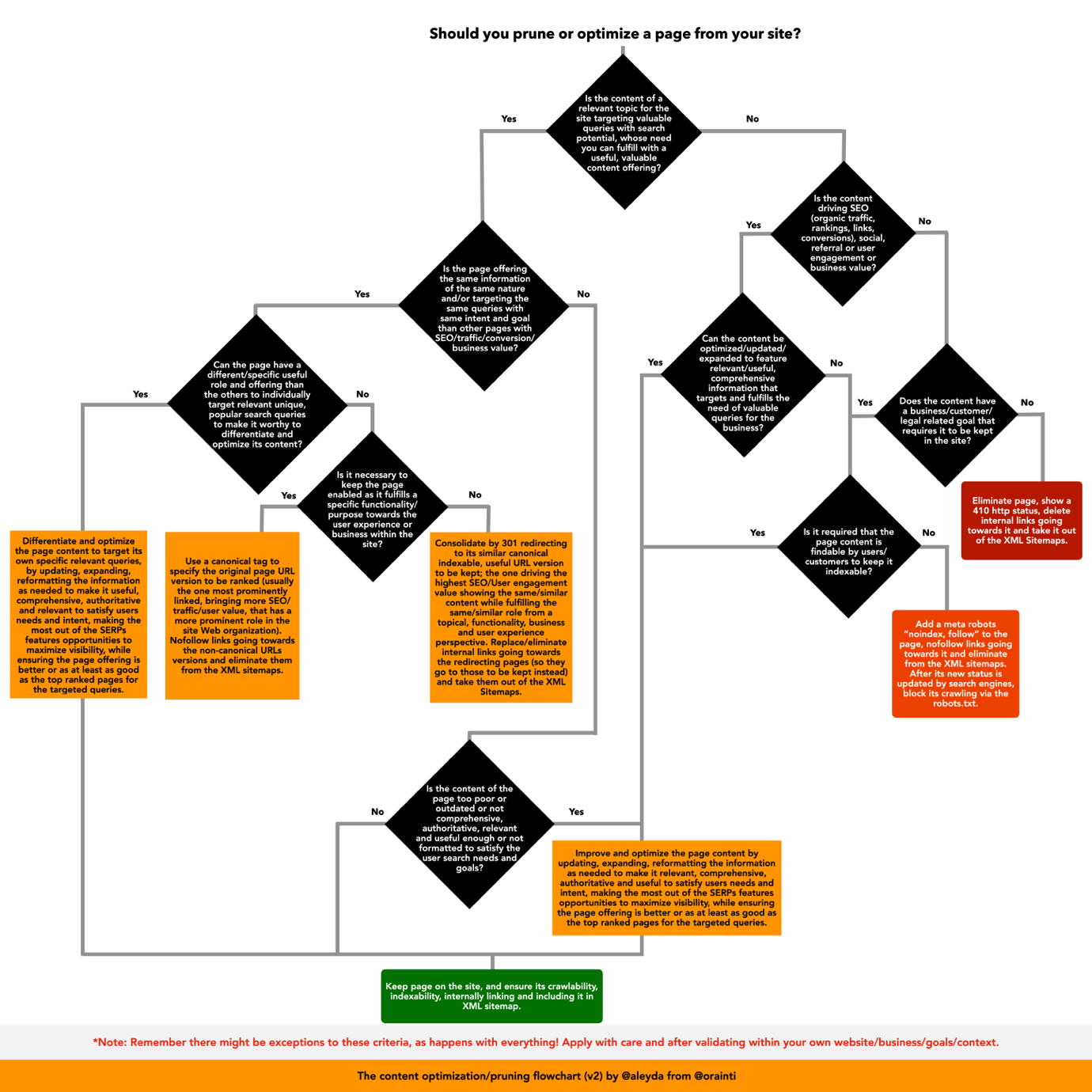
How to Prune your Website Content in an SEO Process

Guide from Aleyda Solis


Step-By-Step Guide: SEO Pruning with Semrush

Guide from Kevin Indig / SEMrush


Why & How Content Pruning Helps Your SEO

Guide from Manish Dudharejia / Search Engine Journal


How To Do Content Pruning To Improve Your Search Rankings

Guide by Bernard Huang

Content Pruning: What People Get Wrong About It and When It's the Right Move

Guide from Blair MacGregor

Content Pruning Tips from SEO Specialists

Explore the following advice and insights from experienced SEO professionals who’ve successfully executed content pruning strategies across various industries and site sizes.

"Prune your content with the goal of delivering value

Evaluate performance before pruning: Examine the performance of content before pruning, dont rely on assumptions - you might be surprised. Assess both SEO impact and conversions. Some pieces may attract fewer visits but have a high conversion rate, making them valuable to business goals.

Consolidate for greater value: If you have multiple pieces of content targeting the same topic, or including overlapping information, consider consolidating them into one comprehensive resource that will be more topically relevant and authoritative. This eliminates redundancy, cuts down on duplicate content, and can enhance user experience.

Remove or update outdated or incorrect content: Content that is no longer accurate, relevant or meets your business goals should be removed or updated. Outdated information can harm bothy our credibility and affect your SEO. For historically significant or posts, or posts that still attract a lot of traffic, try to update it and make it more relevant.

Improve or repurpose low-performing content: Not all underperforming content should be removed.

Address thin content: If you have thin content that delivers very little value or information, consider consolidating or removing the content entirely. You can either add it to a similar article or consolidate all thin content into a comprehensive FAQ/Resources page that may offer more value.

Utilize annotations: When pruning content, always make notes and annotations in your analytics program on what was removed and when. This helps you better spot traffic or conversion trends that arise as a result of your changes.

Repeat regularly: Schedule a time, depending on the size and complexity of your site, to regularly review and prune content. For example, every 6 months enables you to better stay on top of content updates and needs so it doesnt become a chore."
"My number 1 pruning tip: Be more methodical. Diagnose traffic/click losses first then > then decide on what you should prune.

Your pruning efforts will be strategic and more likely to delivery high ROI, which is the ultimate goal of pruning content for scrupmtions SEO gains!

I use two tools: Google Search Console and Semrush:/Ahrefs:

- Run a Click Gap Analysis of queries you've lost gained, and the average position of URLs that have declined. (You compare your last 6 months to the previous 6 months and export the data to Gsheets). Look for:

--URLs with a strong average position that show a steady decline over time.

-- Queries that have lost clicks over time.

+ Bonus tip: Use query data to decide on what specific snippets or updates to add to the content.


- Use position tracking to download the last 3+ months of keywords that have been declining.

- Check for internal links, content relevance (have their been major updates since you last created the content?)

- Use this as a quick "pruning prioritization" tactic."
"A few things I thought I'd bring up:

- I sense pruning has gained even more importance in the recent years, especially since the launch of the Helpful Content System. This is a sitewide signal, meaning that if large portions of the content on a site are considered unhelpful this impacts the whole site, not just the unhelpful pages.

- When pruning: If 301 redirecting to another page, it's worth paying attention to which page you're sending users. Pruning often happens on websites of thousands or millions of pages. But instead of a blanket rule of redirecting everything to the homepage, it's worth creating rules for redirecting to the closest category/subcategory (or 1-2 levels above pruned content).

- A step that has saved me from accidentally killing pages that were actually useful: Importing paid search data into my worksheet. By only looking at organic performance/links when pruning we risk killing pages that are actually being used in Paid search. By cross-referencing organic and paid data I've been able to:
- Align with PPC teams on next steps
- Uncover opportunities to save on Paid budget too (discovering underperforming pages cross-channel and removing them from Paid campaigns too)"
"If removing, combining or optimizing is not possible, you can noindex unhelpful content. Google only valuates indexed pages in the Helpful Content and Core algorithm systems."
"No org traffic for past year?
No direct/social/referral traffic for past year?
No org impressions for past X months?
No Gbot crawls for past X months?
No backlinks?
If no for all, terminate with extreme prejudice
If yes for some, well, it depends"
"My tip is about not exaggerating when using the hatchet. In fact, older content, even if it is outdated, cannot be updated or consolidated with others, helps/helped creating topical authority. If u prune it, you can arm you TA. Prune only the content that clearly is low quality"
"Simulating your internal linking without then pages you want to remove (ie export your links, remove any with pruned page as source) to assert it doesn’t block other pages from being linked. Quite useful analysis with pagination as well."
Content Pruning for SEO FAQs